Sunday, February 12, 2012

We

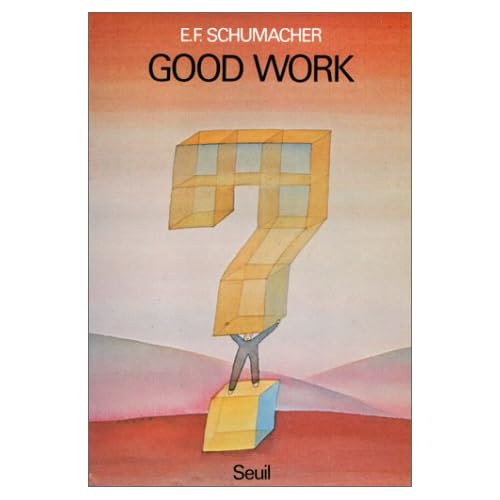
I am reading an anthology of speeches made by E. F. Schumacher which were gathered together under the title Good Work. He writes:
One of the greatest confusions, in most discussions, is the term "we." You know, people say, we ought to decentralize General Motors. I look at them -- I couldn't decentralize the drugstore on the corner! Or we really ought to change human nature -- they couldn't even change their own nature! When I say "we" I am asking what can actual people, small as they are, what can they do?
If you look at it this way, you find if one could make visible the possibility of alternatives, viable alternatives, make a viable future already visible in the present, no matter on how small a scale...then at least there is something, and if that something fits, it will be taken. Suddenly there will be demand. (emphasis mine)
This idea of making alternatives visible seems powerful to me. It points a direction, at least for me. My project in Bakersville will be, I hope, one "viable alternative," one that needs to be made visible in a variety of ways. But there are other alternatives as well, that aren't made visible, or made visible broadly enough so that people who aren't being served by the current system can find it and see whether it fits.
I look at arts organizations like Stage North in Washburn WI or the Northern Lakes Center for the Arts in Amery WI and I feel that they need to be made more widely visible as an alternative.
Such an ongoing project seems perfect for CRADLE. So if you know of arts organizations in small and rural communities that you feel exemplify the possibility of a viable alternative that is rooted in place, sustainable, and participatory, please tell me about it in the comments, or email me at walt828 at gmail.com

Friday, February 10, 2012

Kushner and Schumacher on Education

Fifteen years ago, Tony Kushner delivered the keynote address to the assembled college theatre professors of the US at the Association for Theatre in Higher Education (ATHE) convention. His speech was printed in January 1998 in American Theatre magazine (back when they thought that opinion pieces had a place in their magazine, especially if they were provocative

opinion pieces). I urge you to read the whole essay; I'm rereading it today. And while I'm tempted to quote the whole damn thing, because the whole damn thing needs to be heard not only by the theatrical professoriat but by the artists as well, I will confine myself to just one paragraph, which reads as follows:
Just as the attack on public elementary and secondary education, in the form of the school voucher, and the attack on affirmative action are intended to defeat what's left of the African-American civil rights movement, and the slow whittling away at reproductive rights is intended to defeat what's left of the women's movement, and the Defense of Marriage Act and 36 anti-rights initiatives at the state level are intended to defeat what's left of the lesbian-and-gay-rights movement--and in every instance there's a great deal left--the transmogrification of liberal artseducation into vocational training is, I think, intended to destroy any possibility of a troublesome,restive student population. Not intended as in someone on the National Security Council sat around and planned it (though remembering Cointelpro and Iran-Contra, I wouldn't want to bet a lot of money that hasn't happened), but largely this lamentable state of affairs has come to pass through what Althusser calls "Ideological State Apparatuses." The fact that many of your students wouldn't know what an Ideological State Apparatus is, or what ideology means, and the fact that this general incomprehension is a rather recent development, is precisely what I am talking about. We are being dumbed down. We are being trained, but not trained to think; we are becoming more efficient, by which I mean more exploitable and cooperative laborers, but we are becoming less smart than we can afford to be. Too much action, too little thought: It's not just the formula for an Arnold Schwarzenegger summer blockbuster; it's the formula for what we used to call surplus labor, and for the lumpen-proletariat, before we all forgot what words like that meant....The vocationalization of the liberal arts undergraduate education echoes the loss in the world at large of interest in the grand dialectic of life, in all dialectics, in breadth, in depth, in thinking as a necessary luxury, in the Utopian. The vocationalization of undergraduate education is, I think, akin to all sorts of social malaises, all of which commenced or burgeoned simultaneously with the death of Utopia as a place about which serious adults devote serious thought; and its replacement by corporate-sponsored Never-Never Land, a place in the name of which Peter Pans and Inner Children, instead of reading, devote serious shopping time.
When you've read Kushner's essay, then get a copy of E. F. Schumacher's Small Is Beautiful and read the chapter entitled "The Greatest Resource -- Education." A quote: "know-how is nothing by itself; it is a means without an end, a mere potentiality, an unfinished sentence. 'Know-how' is no more a culture than a piano is music. Can education help us to finish the sentence, to turn the potentiality into a reality to the benefit of man? To do so, the task of education would be, first and foremost, the transmission of ideas of value, of what to do with our lives."

Then read "Buddhist Economics" and think about what Schumacher describes as the Buddhist attitude toward the purpose of work and the arrangement of an economy. Apply to the arts.

Read. Think. Apply, Reflect.

Friday, February 03, 2012

The So-Called Need to Fail

"You've Cott Mail" today is all about "the need to fail." I'm with Adam Thurman on this one: "I've had to learn (the hard way) that the only failures that move us forward are the ones where you prepare and execute to the best of your ability . . . and then things just don't work out." As a college professor, I occasionally am asked by a student, "What do I need to do to get a B in this class?" My answer is always the same: "Try to get an A an don't make it." I don't have much patience with anyone who shoots for mediocrity.

If what is meant is that it is necessary for artists (or anyone else, for crying out loud -- could we get over artistic exceptionalism, please?) to take risks in order to succeed, well, duh. It's not success to keep doing the same safe thing over and over. But failure is something that happens, not something that needs to happen. Sometimes basketball players miss their shots, but they don't need to miss their shots. And the best players, when they miss a shot, keep shooting. What is it Wayne Gretsky said? You miss 100% of the shots you don't take? Exactly. And if you need permission to fail, well, there's not much to say about that -- you have my sympathies. Put on your Big Boy Undies, take a deep breath, prepare, work hard, and roll the big dice.

Wednesday, February 01, 2012

Art in a Human Context

"It would be better if art were nameless, and that those of us who write about art in books and the reviews and newspapers, always clacking about art, or Art, or ART, were constrained somehow by good taste or a hickory club either to do art in its appropriate human context, and in doing be it, or keep still. For art suffers more than most activities in being withdrawn from the contexts of living. It is categorized as something special."

Baker Brownell, The Human Community, 1950 


"Modern art activity can provide a new birth and new creative directions of usefulness for such a community. As art activity is developed, the community is recreated The vital roots of every phase of life are touched As the community is awakened to its opportunity in the arts, it becomes a laboratory through which the vision of the region is reformulated and extended And as the small community discovers its role, as the small community generates freshness of aesthetic response across the changing American scene, American art and life are enhanced."

Robert Gard, Arts in The Small Communities, 1967 

Tuesday, January 31, 2012

On Maturing as an Artist

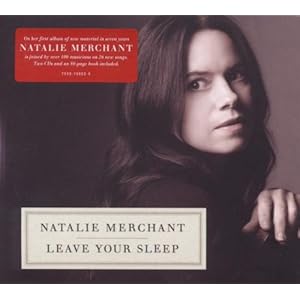
In a fascinating interview on Huffington Post, Natalie Merchant discusses motherhood, her album Leave Your Sleep, and her development as an artist. Among the many thoughtful things she has to say is this exchange (with emphasis added): 
You just announced some upcoming performances as a guest soloist at orchestral shows. Is this the next direction for you? 
I enjoy working with the wide variety of instruments the symphony provides, and the textures and the emotional resonance of those instruments. I'm trying to find a way to mature in this field called pop music, which really loathes the aging process and loves youth. I just feel like I don't want to do the same thing I did when 25 or 35. The songs have endurance and have retained a lot of validity. But I'm focusing on how to make the experience appropriate for the way I feel now, with new material.It's an awkward thing to talk about, but it's true: It's possible to be a musician, but you can't be a pop musician and be a woman and continue in this forever. There's so much lived experience and some wisdom I've gained in my life, and there must be room for that. Emmylou Harris is still making good records; Paul Simon and Peter Gabriel matured and have grown through pop music -- and nobody expects them to do the same thing as they did in their early 20s.
Merchant is talking about pop music, which is has its own unique issues, but I think it there is also an echo in the theatre. When studies like that of the 2010 OOB Survey of Theatre Practitioners, which Tom Loughlin analyzed in a post entitled "Theatre Facts," shows that
  •  67% of all indie actors are between the ages of 21-40, a 19-year span. The highest age group is 26-30 year-olds at 24%. The average age is 36, the median is 33.There is an attrition rate of 50% from the 26-30 age group (24%) to the 36-40 age group (12%). All the percentages over 40 are in single digits. Only 20% of indie actors are between 40-55, a 15-year span.
  • You’re single and childless. 51% of you are single, and 18% are living with a partner (not married). 92% of you have no children. I am assuming this 92% childlessness rate runs across all age groups.
It isn't that plays written and performed by young people lack value -- quite the contrary. But there is something to be said for maturing in a field and writing from the lived experience and wisdom that, as Merchant says, is acquired through living. This is what author Chimamanda Adichi calls "The Danger of a Single Story," something which leads to stereotypes and a lack of richness.  Hollywood films in partoicular suffer from a relentless focus on the fantasies and experiences of youth. This is why a film like, say, The Tree of Life that Issac writes about so movingly seems like a miracle -- it actually addresses the issues of a mature character confronting real life. 
So when we talk about the distribution of arts funding, we're not only talking about diversity of race, gender, and geography, but also of age age and experience. If we have a system that drives people out of the art form as they become older, their experiences and their wisdom and their stories are lost. Which leads to two areas that need to develop: 1) a broader and more sustainable business model and infrastructure for professionals, of course, and (perhaps less obviously) 2) a stronger infrastructure for participatory arts in which people who have rich lived experience are encouraged to share their stories, share their wisdom, share their experiences through all of the arts. 
As an educator of theatre students, I care about #1; as the head of CRADLE, I also care about #2. It seems to me that they go together. We need to create a culture that honors all experiences.

Wednesday, January 25, 2012

Toward an "Organic Theatre"

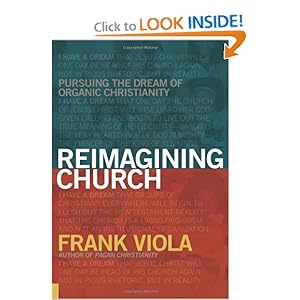
As many of you have probably recognized over the years, one of my favorite things to write about are analogues to the arts I have found, i.e., other fields that are exploring similar issues as those in the arts that can serve to illuminate our own situation. With that in mind, I have just begun reading a book entitled Reimagining Church: Pursuing the Dream of Organic Christianity by Frank Viola. I'm going to quote liberally from the introduction, assuming that you will see the parallels to the arts world, but I'll also make a few halting attempts to make the theatre connection clear.

After declaring a revolution both in theology and practice, Viola writes:
Countless Christians, including theologians, ministers, and scholars, are seeking new ways to renew and reform the church. Others have given up on the concept of church altogether. They have come to the conviction that the institutional church as we know it today is not only ineffective, but it's also without biblical merit. For this reason, they feel it would be a mistake to reform or renew the present church structure. Because the structure is the root problem. (emphasis mine)
Having gestured toward the issue, he then goes on to distinguish between what he calls the "institutional church" and the "organic church." The "institutional church" are
those churches that operate primarily as institutions that exist above, beyond, and independent of the members that populate them. These churches are constructed on programs and rituals more than relationships. They are highly structured, typically building-centered organizations regulated by set-apart professionals ("ministers" and "clergy") who are aided by volunteers (laity). They require staff, building, salaries, and administration. In the institutional church, congregants watch a religious performance once or twice a week led principally by one person (the pastor or minister), and then they retreat home to live in their individual Christian lives.
Viola is quick to add that the term "institutional church" is "not speaking about God's people. I'm speaking about a system. The 'institutional church' is a system -- a way of doing 'church.' It's not the people who populate it. This distinction is important..."

Just in case the analogy isn't clear, speaking in terms of the theatre, the "institutional theatre" would be represented by the regional theatre system, organizations that are highly structured, building-centered, run by professionals who oversee a staff, a building, and give salaries and administer daily activities. The original regional theatres came into existence thanks to the Ford Foundation and the Rockefeller Foundation, and they were structured to look like Ford or Standard Oil -- institutional. Like the "institutional church," the theatre audience comes to the theatre occasionally to watch the professionals perform and then they return home. The "institutional theatre" is a system, a way of "doing theatre," and not the artists and staff who work within it. Neither Viola nor I see the people who populate an institutional church or theatre as somehow unworthy or bad. Most are committed, principled, and creative arts professionals who are passionately devoted to the art form. In addition, Viola writes, and I echo in terms of theatre, "By no means am I criticizing the church. In fact, I'm writing this volume because I love the church very much....Therefore, it's the present practices that I'm seeking to imagine, not the church itself." And he also says he is not saying that an "organic church" is the only right way.

In contrast, the "organic church" operates according to "the same spiritual principles as the church that we read about in our New Testament," the churches of the first century AD. It is "not a theater with a script; it's a gathered community that lives by divine life." An "organic church" as I understand it at this point (and as I said, I've just begun reading and the whole book is devoted to describing an "organic church" -- in fact, Viola wrote an entire book called Finding Organic Church) is small, non-hierarchical, and participatory. There are no specialists -- pastor and minsters -- who organize the service, but instead the service proceeds spontaneously. The meeting place is not a purpose-built building, but rather living rooms and other such places. Early Christians met in small groups in the homes of the congregants and were largely organized collectively, not hierarchically.

An "organic theatre" might follow a similar pathway. Instead of "professional artists" who create a "performance" that the "audience" comes to see in a theatre building, an "organic theatre" would be a small community of people who sometimes perform, sometimes listen -- a sort of ensemble who share their talents with each other in informal spaces. Passive consumption would be unacceptable -- each member would contribute in some way and in a variety of ways -- specialism would not fit. An "organic theatre" wouldn't create a "product" to be sold, but rather members would come together to share gifts, alternately giviing an receiving. There would be no need to spend money on marketing, because the ensemble is both audience and performer -- you would just let the members know about an upcoming event. If there was a desire, performances could be offered outside the group.

In many ways (but not all ways), this is how I conceive of a CRADLE arts organization. The ensemble would encompass as much of the community as possible, and everyone would be alternately audience and participant, giver and receiver, at different times. Events would take place all over the community -- in homes, in church basements, in courthouses, in libraries, in restaurants, in schools, in parks, wherever people might meet, the more creative the place the better. No tickets would be sold, although contributions might be voluntarily made to cover costs. Nobody would "make their living" this way, but together they might make a life, make a community.

This is very much outside the norm, of course, and sounds (even to me) a bit...woo-woo. And yet, I am attracted by the possibility of democratization of creativity, of removing the arts from the market economy and rooting them in the gift economy. I am attracted to the idea of "bringing the arts back home," both literally back into the homes of the community, but also into the hands of the community as well. A consumer culture such as ours relies on a concept of scarcity -- individuals are taught to see themselves as lacking in some regard, and encouraged to fill that lack through a purchase. In this case, we purchase stories about strangers which are told to us by strangers.

What if we proceeded from a concept of abundance? The assumption that we all have things we can share, and that the act of sharing them enriches both giver and gifted. That the value is found in generosity rather than virtuosity, connection rather than quality, circulation rather than specialization.

How might attitudes towards the arts be changed if this possibility were available? How might communities small and large be transformed? How might creativity be enhanced and spread far and wide?

I don't know. I am groping toward an alternative to the institutional system.
What Needs to Happen to Theater