Wednesday, January 25, 2012

Toward an "Organic Theatre"

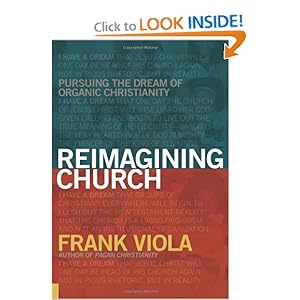
As many of you have probably recognized over the years, one of my favorite things to write about are analogues to the arts I have found, i.e., other fields that are exploring similar issues as those in the arts that can serve to illuminate our own situation. With that in mind, I have just begun reading a book entitled Reimagining Church: Pursuing the Dream of Organic Christianity by Frank Viola. I'm going to quote liberally from the introduction, assuming that you will see the parallels to the arts world, but I'll also make a few halting attempts to make the theatre connection clear.

After declaring a revolution both in theology and practice, Viola writes:
Countless Christians, including theologians, ministers, and scholars, are seeking new ways to renew and reform the church. Others have given up on the concept of church altogether. They have come to the conviction that the institutional church as we know it today is not only ineffective, but it's also without biblical merit. For this reason, they feel it would be a mistake to reform or renew the present church structure. Because the structure is the root problem. (emphasis mine)
Having gestured toward the issue, he then goes on to distinguish between what he calls the "institutional church" and the "organic church." The "institutional church" are
those churches that operate primarily as institutions that exist above, beyond, and independent of the members that populate them. These churches are constructed on programs and rituals more than relationships. They are highly structured, typically building-centered organizations regulated by set-apart professionals ("ministers" and "clergy") who are aided by volunteers (laity). They require staff, building, salaries, and administration. In the institutional church, congregants watch a religious performance once or twice a week led principally by one person (the pastor or minister), and then they retreat home to live in their individual Christian lives.
Viola is quick to add that the term "institutional church" is "not speaking about God's people. I'm speaking about a system. The 'institutional church' is a system -- a way of doing 'church.' It's not the people who populate it. This distinction is important..."

Just in case the analogy isn't clear, speaking in terms of the theatre, the "institutional theatre" would be represented by the regional theatre system, organizations that are highly structured, building-centered, run by professionals who oversee a staff, a building, and give salaries and administer daily activities. The original regional theatres came into existence thanks to the Ford Foundation and the Rockefeller Foundation, and they were structured to look like Ford or Standard Oil -- institutional. Like the "institutional church," the theatre audience comes to the theatre occasionally to watch the professionals perform and then they return home. The "institutional theatre" is a system, a way of "doing theatre," and not the artists and staff who work within it. Neither Viola nor I see the people who populate an institutional church or theatre as somehow unworthy or bad. Most are committed, principled, and creative arts professionals who are passionately devoted to the art form. In addition, Viola writes, and I echo in terms of theatre, "By no means am I criticizing the church. In fact, I'm writing this volume because I love the church very much....Therefore, it's the present practices that I'm seeking to imagine, not the church itself." And he also says he is not saying that an "organic church" is the only right way.

In contrast, the "organic church" operates according to "the same spiritual principles as the church that we read about in our New Testament," the churches of the first century AD. It is "not a theater with a script; it's a gathered community that lives by divine life." An "organic church" as I understand it at this point (and as I said, I've just begun reading and the whole book is devoted to describing an "organic church" -- in fact, Viola wrote an entire book called Finding Organic Church) is small, non-hierarchical, and participatory. There are no specialists -- pastor and minsters -- who organize the service, but instead the service proceeds spontaneously. The meeting place is not a purpose-built building, but rather living rooms and other such places. Early Christians met in small groups in the homes of the congregants and were largely organized collectively, not hierarchically.

An "organic theatre" might follow a similar pathway. Instead of "professional artists" who create a "performance" that the "audience" comes to see in a theatre building, an "organic theatre" would be a small community of people who sometimes perform, sometimes listen -- a sort of ensemble who share their talents with each other in informal spaces. Passive consumption would be unacceptable -- each member would contribute in some way and in a variety of ways -- specialism would not fit. An "organic theatre" wouldn't create a "product" to be sold, but rather members would come together to share gifts, alternately giviing an receiving. There would be no need to spend money on marketing, because the ensemble is both audience and performer -- you would just let the members know about an upcoming event. If there was a desire, performances could be offered outside the group.

In many ways (but not all ways), this is how I conceive of a CRADLE arts organization. The ensemble would encompass as much of the community as possible, and everyone would be alternately audience and participant, giver and receiver, at different times. Events would take place all over the community -- in homes, in church basements, in courthouses, in libraries, in restaurants, in schools, in parks, wherever people might meet, the more creative the place the better. No tickets would be sold, although contributions might be voluntarily made to cover costs. Nobody would "make their living" this way, but together they might make a life, make a community.

This is very much outside the norm, of course, and sounds (even to me) a bit...woo-woo. And yet, I am attracted by the possibility of democratization of creativity, of removing the arts from the market economy and rooting them in the gift economy. I am attracted to the idea of "bringing the arts back home," both literally back into the homes of the community, but also into the hands of the community as well. A consumer culture such as ours relies on a concept of scarcity -- individuals are taught to see themselves as lacking in some regard, and encouraged to fill that lack through a purchase. In this case, we purchase stories about strangers which are told to us by strangers.

What if we proceeded from a concept of abundance? The assumption that we all have things we can share, and that the act of sharing them enriches both giver and gifted. That the value is found in generosity rather than virtuosity, connection rather than quality, circulation rather than specialization.

How might attitudes towards the arts be changed if this possibility were available? How might communities small and large be transformed? How might creativity be enhanced and spread far and wide?

I don't know. I am groping toward an alternative to the institutional system.

Monday, January 16, 2012

In Honor of Martin Luther King

While there will be many tributes today to the vision and determination of Martin Luther King, from artists and non-artists alike, I think the best thing the arts as a field could do would be to take seriously the Fusing Arts, Culture, and Social Change report and address the inequities that are built into the non-profit arts infrastructure.

Lately, we have seen the enormously negative effects of Big Money in politics through the creation of Super Pacs and the lifting of limitations on corporate political contributions as a result of Citizens United. Well, this situation has long been in place in the arts. The wealthy and powerful dominate governing boards, and major institutions court major donations from rich individual donors and their foundations. And then we wonder why the money is centralized in elite, white, urban institutions and why those institutions present art that appeals to that demographic.

It is important that CRADLE not fall prey to this pattern. Local CRADLE organizations should have boards comprised not only of town leaders and elites, but of people representative of the population as a whole. This means choosing board members not for their ability to contribute and raise money, but for the value of their viewpoint and wisdom.

In the book The Abundant Community: Awakening the Power of Families and Neighborhoods, authors John McKnight and Peter Block call on citizens to create powerful and competent communities based on three "universal properties":

  • The Giving of Gifts -- The gifts of the people in our neighborhood are boundless. Our movement calls forth those gifts.
  • The Presence of Association -- In association we join our gifts together, and they become amplified, magnified, productive, and celebrated.
  • The Compassion of Hospitality -- We welcome strangers because we value their gifts and need to share our own. Our doors are open. There are no strangers here, just friends we haven't met.
The latter is particularly important, as it promotes what Block calls a "welcome at the edge." It isn't only the rich and powerful who have gifts to offer, but those who have been traditional ignored or marginalized. And those must be actively sought out and celebrated.

We must not continue to waste the talents of our people. We must not continue to ignore the stories of our people. We must celebrate the richness that exists in all people. And we must create an artistic infrastructure that promotes these values.

Sunday, January 08, 2012

Build a New Model

The arrival of a new year often leads to reflection on what has passed, and as a result points to new directions for what is to come in the future. For a theatre blogger who has been writing over 6 years, this is particularly true.

For a few weeks, I was considering discontinuing Theatre Ideas. Over the time I have written it, I have questioned many aspects of the theatrical status quo, and proposed ways to make it better. I have participated in important discussions, and written a few posts that have garnered  thousands of hits. And I have received several invitations to participate in convenings and submit grants as a result of writing this blog. As a result of writing this blog, my own ideas have come into greater focus.

What was getting me down is that nothing seems to really change. A topic rises to the forefront of everyone's consciousness, there is a certain amount of heat, a much smaller amount of light, and then -- pffftt! The discussion is over, and everyone goes back to talking about how to use Facebook and Twitter to market their productions, as if the only thing standing in the way of a vibrant theatre scene is just finding a way to get the word out. We're all for diversity -- yay! -- except don't ask us to do anything different. We're all for theatre for everyone -- yay! -- except don't ask us to do anything to promote it. We're all for new plays -- yay! -- but don't ask us to give up our classics. We're all for a more even distribution of funding -- yay! -- but don't actually take any money away from the richest institutions. The power of inertia seems to be bred in the bone.

It is time for me to take seriously the Buckminster Fuller quotation in the sidebar of this blog: "You never change things by fighting the existing reality. To change something, build a new model that makes the existing model obsolete." I have spent six years fighting the existing reality, which regardless remains stubbornly unchanged. My focus must now be on building a new model.

As many of you know, I have received funding to create a CRADLE pilot program in Bakersville, NC (pop 357), where I will be moving within the next few months. That is a concrete attempt to create a new model. I will blog about that process on the CRADLE blog.

I've also decided to organize my thoughts and ideas into a book with the working title "Small is Artful," which I may create a separate blog for. The book will address issues of scale in theatre as it impacts everything from location to business model to aesthetics to production methods. Whether I will publish this book myself or through a traditional publisher remains to be seen. Hell, whether I find the time to write it remains to be seen. Suffice to say that it is time to bring together the research and ideas that I have expressed over the years on this blog and put them into a more formal, organized, and portable format.

I'll continue to write here and on the CRADLE blog (where my absence has gone on for too long), but my thoughts will be focused forward to a new model, rather than engaging the current one.

Friday, December 23, 2011

An Idea That Everyone Will Hate

IN A COUPLE POSTS on Parabasis, Isaac Butler has contributed two commentaries concerning the increasingly blurred lines between the profit theatre and the nonprofit theatre. This is an issue upon which Rocco Landesman has repeatedly commented quite powerfully, both as head of the NEA and long before. This is an issue that intersects with many of my own concerns about the increasing centralization of the theatre in New York as well as the centralization of arts funding in large theatres, many of whom rather regularly transfer their productions to Broadway.
    While I was thinking about this issue and how best to address it, I came up with an idea that absolutely everybody will hate which, if I were an avant garde artist, I would see as proof that it is an excellent idea. And while I acknowledge its likelihood of universal horror, and also the complicated details that would be involved, I am going to share it anyway as a "modest proposal"" offered to provoke thought if nothing else.
    So here it is -- for simplicity's sake, I will give it a narrow focus:

  • Any theatre that transfers a production to a commercial venue automatically loses its non-profit status.
Actually, this wasn't the radical idea. Rather, it was the next step that was radical, because it makes this prohibition work both ways:

  • In order to maintain its 501(c)3 status, a non-profit theatre is not allowed to produce a play that has been done on Broadway or employ an artist who has worked in the commercial theatre, television, or film.
Yeah, that's the kicker.
     This would have the immediate negative effect of reducing artist income and, indeed, would likely substantially reduce the theatrical workforce. In fact, it might seriously cripple the theatre scene, at least for a while.
   On the other hand, it would draw a bright line between the nonprofit world and the commercial world, eventually creating a workforce focusing all of its artistic energy on developing the theatre. No longer would the nonprofit theatre be a stepping stone for playwrights, actors, directors, and designers to make a jump to commercial art forms. No longer would regional theatres across the US produce, cookie-cutter-like, the latest Broadway hit. No longer would we have articles in American Theatre making excuses for playwrights heading to Hollywood to write TV shows. No longer would theatre actors spend their time trying to land a national commercial or a bit spot on CSI. Theatre artists would have to commit, and if they wanted to do a TV series, film, or Broadway show, they would know that there was no going back.
   Imagine the amount of great theatre the world might have seen if the Steppenwolf actors had been doing play after play year after year instead of spending most of their time doing movies and TV series. Imagine if Tony Kushner had focused his enormous talent on writing play after play for Magic Theatre instead of trying to figure out a way to make a smart Broadway musical.  Imagine the richness that might have entered the theatre if the only people working in it were those who had committed their lives and talents totally to it. Imagine the collaboration that might happen between regional theatres looking to share the work of their playwrights. The nonprofit theatre world would be immeasurably enriched by being populated only by theatre artists who have committed their careers to its development.
   Yeah, I know -- the free flow of labor.
   But unless something like this happens, the nonprofit theatre will continue to be used as the minor leagues for commercial art forms that contribute to the cultural sludge that pollutes our nation. We need to quarantine the corporate values that have infected the commercial theatre. It isn't good for the art form; it isn't good for our culture.

Wednesday, December 14, 2011

Arlene Goldbard on the NCRP Report

Arlene Goldbard's outstanding book
I was tempted to call this "Occupy Wall Street (part 5)," but arts consultant and thinker Arlene Goldbard, author of the powerful book The New Creative Community: The Art of Cultural Development (which I think every artist ought to get as a Christmas present), has written a powerful post in reaction to the Fusing Arts, Culture and Social Change report as well as the discussion going on at Grantmakers in the Arts Forum on Equity in Arts Funding. Please, please go read it. It is entitled: "Equity in Cultural Funding: Let Them Bake Pies."

Here's a taste: Goldbard's conclusion:


 I salute the very few funders who’ve demonstrated it. To the rest, I pose a few questions not mentioned so far in the study or the forum:
  • What would it take for you to face the assumptions and ways of organizing that perpetuate them-that’s-got-shall-get funding?
  • What would it take for you to step up to the challenge of adopting egalitarian, democratic, social justice commitments in their place?
  • What would it take for you step off the path on which so much philanthropy has been dependent, and truly share power?
  • What would it take for you to embrace learning from failure, abandon corporate models, and truly break with the conventions that keep our philanthropic culture entrenched, inequitable, and stuck?
If the answers are within your grasp, what’s stopping you? And if—sadly—you can’t conceive answers that can actually be enacted, well, let’s try facing that truth now.

Sunday, December 11, 2011

Occupy Lincoln Center (part 4)

 The first three parts of this series each pointed at different aspects of the problem of the concentration of funding in the nonprofit arts sector. First, the overview of the situation in philanthropic giving; second, the consequences of such concentration when it comes to many different kinds of diversity (audience served, aesthetics preferred, geographies ignored, demographics slighted); and third, the urbanization of theatre as reflected in funding from the NEA. These parts should be read as a whole, a single long essay examining from different angles the inequities of arts funding in the US.

So what is to be done? This is a question so often asked of the Occupy Movement: what do you want, what are your demands, what are your solutions. While I am not an expert in the Occupy Movement, my impression is that it is comprised of a very diverse group of people who represent different priorities and different ideas of what is to be done, but that they agree about one thing: the income disparity in the US is wrong. Their protest is a moral one that points at gross inequity that has ramifications for all aspects of American society, and declares it wrong.

That is an important first step for a rebellion, and it is the step that I, too, am making with these posts. Before proposing "solutions," it is important for as many people as possible, both within the profession and outside it, to actually see the inequity, recognize its extremely negative effects on the American arts ecosystem, and declare it wrong. Easier said than done.

Over the past weeks, I have encountered many members of the arts community who profess to sincerely support the points being made, but fret that any change to the status quo will negatively impact those who are currently highly privileged.  Some have expressed a desire for a single, simple solution that rights the wrongs without causing any change to the status quo. Others, such as TCG's Executive Director Teresa Eyring, have defended the status quo, pointing out that, while it may look like there is inequity, well, those really rich organizations actually help smaller organizations."What the numbers and this study don’t capture," Ms. Eyring opines, "are the often invisible ways in which larger and mid-sized organizations deploy financial, human and capital resources for the benefit of individual artists, smaller organizations and diverse communities. These systems of mutual support often go unnoticed by the wider public, but they are tremendously valuable. As we continue our conversation about funding equity, we must also acknowledge the impact of the actions these larger theatres are taking, and share models that are working." She then goes on to list all the yummy things that organizations like La Jolla Playhouse and Children's Theatre Company in Minneapolis have done. Why, La Jolla has actually let one small organization a year do a show or two in their space rent free, and even offered sound and lighting support and advice about marketing! Such largess is simply breathtaking. She goes on: "When C[hildren's] T[heatre] C[ompany] premiered Nilo Cruz’s adaptation of Gabriel Garcia Marquez’s A Very Old Man With Enormous Wings, [music director Viktor] Zupanc searched for local musicians playing in South American traditions. He found and hired a harpist from Paraguay, a percussionist from Brazil, a guitarist from Argentina and a flute/pan pipe player from Ecuador, and CTC paid for all of them to join the local musician’s union." She concludes breathlessly, " Not only did this build unexpected ties to emerging artistic communities in Minneapolis, but the music was gorgeous!"

We might call this "trickle down arts funding," a concept that has been proven worthless in the economy as a whole, but which Ms. Eyring apparently thinks works just fine in the nonprofit arts sector. As you might expect, I don't find these artistic breadcrumbs persuasive as a reason to continue the status quo. The fact that the head of, say, Citibank occasionally tosses a couple bucks in the hat of a homeless person doesn't undo the fact that the economic income disparity is simply wrong.  That Ms. Eyring apparently does think it is enough simply reinforces my sense that the Theatre Communications Group no longer truly serves the regional theatre field, but is rather an advocacy group for the privileged.

While I have not had an opportunity to read all of the blog posts by arts professionals and philanthropists in the discussion of the report happening at the GIA blog (which is where Ms. Eyring offered her "insights"), I did have an opportunity to read William Cleveland's contribution. Cleveland, who has long been involved in community-based arts, contributes a series of questions that he thinks we all ought to ask ourselves:
  • Is cultural equity a core value that informs our work? If not, why?
  • If so, how specifically do we define it and hold ourselves accountable?
  • If we looked hard at the patterns of cultural investment by our organization and across our community, over time, what would we find?
  • If there were a significant “gap” between our stated values and this investment history, what would we do?
I think these are good questions that can lead to personal reflection, but right now I simply want arts professionals and philanthropists to declare the status quo wrong. Not to engage in soul-searching, not to comment on how "interesting" the report is, not to comment on how interesting it is that it has gotten so much media attention, and certainly not defend the indefensible as Ms. Eyring does, which is just embarrassing. But just to take a clear moral stand and declare it wrong. I don't want excuses, reasons, or rationalization; I want these arts leaders to say, in no uncertain terms, that this income and wealth disparity among nonprofit arts organizations and within nonprofit arts philanthropy is wrong. Period.


Doug Borwick, in an excellent response to this series of posts, reminds us that "“arts” is not in the tax code’s authorizing language for tax exempt entities. We sneak in under “education.”" If education funding was distributed like arts funding -- if most of the money went to educate wealthy, urban white people in a few states -- the hue and cry would be deafening, and anyone who defended it would be excoriated. Why is this not the case with arts funding, if it indeed receives its tax deductability from its educational contribution to American society?


So I want theatre artists, arts leaders, and arts philanthropists declare the status quo wrong. Once I hear that, then we can discuss possible solutions. But as long as there are people weaseling around making excuses for a system that destroys the many while privileging the few, that contributes mightily to the tragedy of unrealized artistic potential, there is no point exploring solutions. It is time for arts leaders such as Rocco Landesman, Ben Cameron, all the people who blogged at the GIA, and anybody in a leadership position at a 2% arts org or foundation to say unequivocally and directly that this situation is wrong. Those voices need to be joined by individual artists across the US to affirm that the current centralization of artistic resources is wrong.

It is time to stand up. Please sign the above petition. If you are a Twitter user, please make your voice heard by tweeting your support with the hashtag #It'sJustWrong.

Wednesday, November 23, 2011

Occupy Lincoln Center (part 3)

On October 26th, one of the great pioneers of the regional theatre movement, Zelda Fichlander, addressed the assembled Stage Directors and Choreographers Society in celebration of the 3rd annual award named in her honor. The invaluable on-line journal HowlRound posted the text of her speech, in which Fichlander spoke passionately about the early history of the regional theatre movement and the values that formed its foundation. I take a back seat to no one in my admiration for Fichlander, who has provided strong leadership and a vital moral voice in the regional theatre and theatre education for decades. That said, there is a portion of the speech that is, frankly, inaccurate and one that propagates a myth about the development of the regional theatre movement that supports the lack of diversity that is revealed in the Fusing Arts, Culture and Social Change report that has been discussed in the first two parts of this series.

About a third of the way through her speech, Fichlander talks about a meeting she had with the true founder of the regional theatre movement, Margo Jones, when Fichlander was founding the Arena Stage. She asked Jones whether she was doing the right thing, and Jones offered her insights, "and then came the prophecy that appeared later in her book, Theatre-in-the-Round," Fichlander says: “I dream of 40 of these theatres all around America, that’s what we need to have.” She didn’t live long enough to see what happened, but it happened as she said it would. It did grow to forty, and now it’s over 1,000."

Now, it may be that Fichlander is accurately reporting what Jones said to her in that meeting, but it is certainly not what Jones said when, sixty years ago, she published her vision for the regional theatre. On the second page of the book, she writes the following:
"What our country needs today, theatrically speaking, is a resident professional theatre in every city with a population over one hundred thousand. According to the 1940 census figures, there are over one hundred such cities in the United States. For reasons which will become evident in this book, I believe it would be easier to start in the larger centers, although I am certain that once all these cities acquired resident professional theatres, smaller communities would want them, too; and possibly within some ten years the one hundred and seven cities whose population runs from fifty to one hundred thousand would also have their own theatres...I believe that the best way to assure quality is to give birth to a movement which will establish permanent resident theatres throughout the country."
That's the prophecy, that's the vision. First, resident theatres -- theatres with a permanent company at its core. That certainly has not happened with most regional theatres, who job in actors from New York on a per-show or per-season contract. That has reinforced the centralization of the artistic workforce, and undermined the greatness that can result from artistic continuity.

More important to this discussion is Jones' vision of geographic diversity. Not forty theatres, as Fichlander would have us believe, but a theatre in every city of 100,000 and ten years later one in every community with a population of 50,000. How has that vision worked out in actuality?

Reality
According to the League of Resident Theatres member list, there are 76 such theatres in the United States. While almost twice as many as the forty remembered by Ms. Fichlander, it is well short of the one hundred envisions by Jones even using the census of 1940 when there were far fewer cities over 100,000.

Of those 76 theatres, sixteen (21%) had populations under 250,000 and 12 (15.7%) had populations between 50,000 and 100,000.

Of those twelve with populations between 50,000 and 100,000, only three were in counties under 250,000. Why does this matter? Because it is an indication that most of these cities are suburbs of larger cities. We're talking Skokie IL, Cambridge and Lowell MA, Jupiter FL, Pasadena and Costa Mesa CA.

Oh, and nationwide, the percentage of counties with populations under 200,000? 91%.

Further, an examination of the demographics for these smaller LORT cities reveals that the average median household incomes for the group of $66,720. Compared to $45,018 for the US as a whole, this is almost 1.5 times the national figure.

So once again, we find that the vast majority of theatres are urban; of those in smaller cities, they tend to be wealthy suburbs of metropolises.

Margo Jones would not be thrilled. Nor would the Occupy Wall Streeters.

My research has also shown that funding from the National Endowment for the Arts is also centralized in certain states of the union, with New York and California getting the lion's share. The latest round of Our Town funding is no exception: New York and California received 44% of the total grants awarded, and the same percentage of the money awarded. When Illinois is included, it ends up with 50% going to just three states. Once again, these reflect the centralization of funding in certain areas.

Another Goal
Meanwhile, according to the Rapid City Journal, Rocco Landesman, "on his way out of South Dakota after visiting Red Cloud Indian School’s Heritage Center...stopped Thursday in Rapid City with a message: Art is the product of its place.“This is probably the best example of that that I’ve seen anywhere in the country,” said Rocco Landesman, who is finishing a three-state tour to visit organizations with grant money from the endowment. “You visit the Heritage Center and see Native American art produced by the people in those tribes, the Lakota people right there. It’s so obvious that it’s tied to that place; that this couldn’t happen in Malibu or New York City.”

South Dakota is one of three states that received no grant money from the NEA in this round of the Our Town Art Works grant program. Nor did they receive any in the last round of the Our Town grants. The other two states: North Dakota and Nevada. Nevada didn't get any Our Town grants in the last round, either.

Further, and examination of the percentage of submitted grants that were actually funded in the last round of the Our Town program reveals that proposals from cities with populations over a million had a 100% acceptance rate, whereas those from cities under 100,000 had an acceptance rate of less than 40%.

As the National Committee for Responsive Philanthropy report indicates, and as this data reinforces, rural communities are severely neglected. "The economics of cultural philanthropy are extremely skewed and this restricts the ability of thousands of artists and smaller cultural organizations to advance their practice and contribute substantively to their communities." Sidford writes in the NCRP report.
"Culture and the arts are essential means by which all people explain their experience, shape their identity and imagine the future...People need the arts to make sense of their lives, to know who they are. But our democracy needs the arts, too. The arts animate civil society. They stretch our imagination. They increase our compassion for others by providing creative ways for us to understand and deal with differences. The arts protect and enrich the dignity and the public discourse that are at the heart of a healthy democracy."
Meanwhile, back in South Dakota, Landesman echoes the  same sentiment. "Studies show that introducing art in communities like Hill City, which has seven art galleries although the population is under 1,000, changes the economics and people who live there, Landesman said.“This is the real work, I think of the NEA, to get out there, to get around and to engage art where it’s happening and to promote that,” Landesman said. “When you bring art and artists into a place it changes that place. It changes that community.”

Perhaps the peer review panels who award grants didn't get that memo. Or perhaps this is just public relations while the NEA and the philanthropic foundations go on reinforcing the status quo. But I ask Mr Landesman, and people who head large philanthropic organizations like, say Ben Cameron at the Doris Duke Foundation:  why should the transformative, community-building benefits of the arts be confined to metropolitan areas and rich suburbs?

If this is truly the National Endowment for the Arts, perhaps there ought to be a bit more focus put on the nation as a whole. Perhaps that "real work" Landesman spoke of ought to include actively seeking and rewarding a more diverse pool of arts organizations. If we want to promote the arts throughout the nation, then we have to promote arts funding throughout the nation. Giving 55% of the arts funding to 2% of the arts organizations that reside primarily in a few metropolitan areas serving a rich group of patrons is simply wrong. There is no defense for it other than stubbornly ingrained elitism.

What Needs to Happen to Theater